
Decision guide · office-space selection
How to Choose Office Space for Your Company?
How to define the space you need, choose a location and compare lease terms before making a decision.
It makes sense to start reviewing specific offers only after you know how much space the company needs, which locations are convenient for the team and what budget is reasonable over the full lease term. The headline rent does not show the full cost, and the floor area in a listing does not tell you whether the unit can accommodate the functions you need. This guide takes you from company needs and move timing, through location and type of space, to comparing specific offers, lease terms and the technical verification of finalists before signing.

Short answer
Office selection starts with the company programme, not with property listings
Before you create a list of addresses, define the number of users, how the company works and which functions need to be included in the new workplace.
Key conclusion
A good office is selected around the needs of the company, not the photographs in the listing. Start with headcount, work model and the functions you need, then calculate the floor area that follows from them. Next, define an acceptable cost level and the parts of the city that work for the team. Only then can specific units be compared on the same basis. The best two or three should undergo technical due diligence before negotiations are closed.
Step 1
Programme and area
How many people, what work model, which functions and how much space.
Step 2
Total budget
Rent, charges, utilities, parking, fit-out and relocation.
Step 3
Area and type
Location, team commute, type of space and building standard.
Step 4
Offers and terms
Common-basis comparison, negotiations and technical verification.
Once the choice has been narrowed to two or three units, offer ranking alone is no longer enough. Before signing, it is worth confirming ventilation capacity, electrical power, fire-safety requirements, handover condition and scope of works. A related Ecoffices guide covers office fit-out risk and technical constraints.
Benefit: defining the required area and budget before the first commercial discussions makes it much easier to reject offers that do not fit the company and focus negotiations on real alternatives.
Work backwards from the deadline
When to start looking for a new office
Negotiations are most difficult when little time remains on the current lease and the company no longer has a credible alternative.
Set the start date by working backwards from the planned move, not from the expiry date of the current lease. Allow time for selection, negotiations, design, approvals, construction and the move itself. For a medium-sized office, that usually means more time than the first programme assumes.
| Office size | When to start before the move | Why this much time |
|---|---|---|
| up to 300 m² | 9–12 months | shorter selection process, but works and approvals still take time |
| 300–1,000 m² | 12–15 months | complete programme, commercial negotiations, design and fit-out |
| above 1,000 m² | 15–24 months | longer negotiations, larger scope of works and sometimes construction-stage coordination |
| Space in a building under construction | depends on the handover date | the tenant has to align with the development programme |
Notice deadline and handback date for the current office
Notice deadline under the current lease
Latest possible date
Missing the deadline can mean an automatic extension for another period.
Current-office handback date
When the premises must be empty
The programme should also include the time needed to reinstate the current space to the condition required by the lease.
Common problem: the company starts searching six months before its current lease expires, finds a strong option, but cannot complete the fit-out in time. It is then left choosing between a short extension of the current lease on the landlord’s terms and a weaker unit that happens to be immediately available.
Starting point
The company’s work model is the starting point for the office programme
The same number of employees may need a completely different office depending on how often people are on site and how they use the workplace.
The office programme should answer specific business needs: the number of workstations, offices and meeting rooms, the number of places for calls and focused work, kitchen size and the required support areas. Useful inputs include attendance data, meeting-room utilisation, hiring plans and the problems reported by teams in the current office.
Attendance data
Actual office entries from access-control data or desk-booking systems over the last six to twelve months, broken down by day of the week.
How meeting rooms are used
How many meetings take place, in what group sizes and how many are remote calls that require a separate room.
Conversations with teams
Which teams need to sit together, who is affected by noise, who needs confidentiality and what the current office prevents people from doing effectively.
Headcount plan
Forecast for the lease term, not just the next year. Three scenarios rather than one number.
How the work model affects the floor area
| Model | Impact on workstation count | Impact on the rest of the programme |
|---|---|---|
| Full attendance | one desk per person | fewer meeting rooms per person, greater need for quiet-work zones |
| Hybrid with fixed office days | mid-week peak attendance determines workstation count | risk of overcrowding on Tuesday and empty space on Friday |
| Hybrid without fixed days | desk sharing is possible, but a booking system is needed | more lockers and more rooms for remote meetings |
| Mainly remote work | the office becomes a meeting place rather than a place for individual desk work | more meeting rooms, workshop space and shared areas |
Data worth collecting
- What was the highest daily attendance during the last six months and how often did it occur?
- How many meetings take place in rooms larger than necessary because smaller rooms are unavailable?
- How many people regularly work in the kitchen or corridor because there is no suitable place for calls?
Benefit: well-calculated requirements protect the company both from paying for unnecessary floor area and from moving into an office that becomes too small after a year.
Floor area
How many square metres of office space does a company need?
Multiplying the number of desks by workstation area never gives the complete answer. The programme also includes meeting rooms, support areas and circulation.
For a company employing 75 people, the complete reference programme is approximately 723 m², or 9.6 m² per person. It includes workstations, offices and team rooms, 22 meeting seats of different sizes, 8 quiet-work seats, a kitchen and dining area, technical support space and circulation.
Team
75people
Programme area
723m²
Per person
9.6m²
Meeting seats
22
| Metric | Typical range | What moves it |
|---|---|---|
| Complete programme area per person | 8–12 m² | number of offices, size of support areas, standard |
| Desks per person | from 1.0 to around 0.6 | attendance policy and predictability of peak days |
| Share of meeting provision | increases in hybrid work models | number of remote meetings and team sizes |
| Growth allowance | usually 5–15% of the programme | headcount plan and lease length |
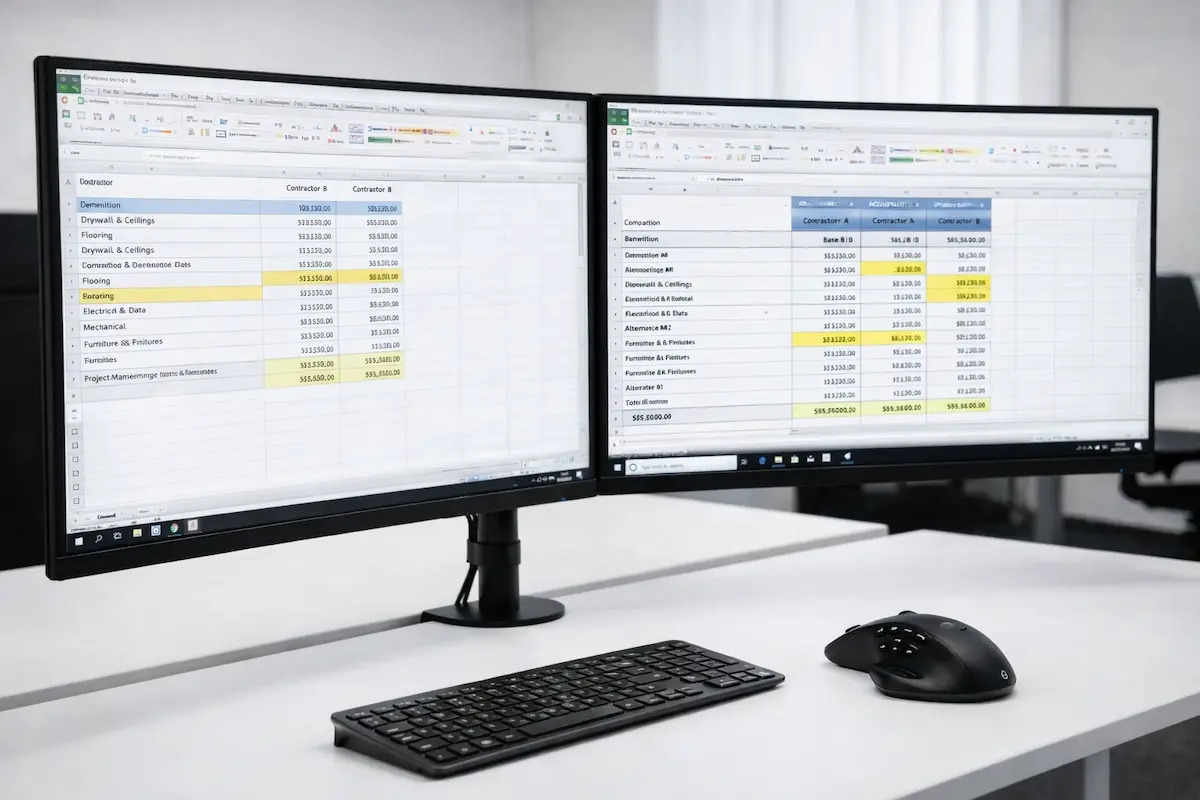
Be careful when comparing figures: the area quoted in a lease offer is the charged lease area and includes a share of the building’s common areas. The company programme is calculated on the usable area of the premises. Comparing one with the other can overstate real workplace capacity by several per cent.
Budget
Total office cost instead of headline rent alone
Rent is only one item. The real cost also includes service charge, utilities, parking, space preparation, equipment and relocation-related costs.
For a 723 m² office for 75 people, the monthly bill can look like this. It is worth structuring your own offers in exactly the same way — with rent, service charge, utilities and parking shown separately.
| Item | Assumed rate | Monthly |
|---|---|---|
| Base rent | €15/m² at EUR/PLN 4.30 | about PLN 46,600 |
| Service charge | PLN 32/m² | about PLN 23,100 |
| Parking | 15 spaces at PLN 600 | PLN 9,000 |
| Tenant utilities | PLN 8/m² | about PLN 5,800 |
| Total monthly occupancy cost | — | about PLN 84,500 |
That is approximately PLN 1.015 million per year and about PLN 1,130 per person per month. On top of this come one-off costs: fit-out, furniture and equipment, relocation, IT infrastructure and reinstatement of the old office to the condition required by the lease. When comparing offers, it is useful to spread these costs across the lease term so that the alternatives can be compared as one number.
How much one parameter can change a five-year lease
Base rent higher by €1/m² per month
PLN 187kover the full five-year lease
Three rent-free months
PLN 140ksaving for the tenant
One rent-free month
PLN 47k
Service charge higher by PLN 1/m²
PLN 43k
Five additional parking spaces
PLN 180kfor five additional spaces over five years
Add-on factor higher by 1 percentage point
PLN 27k
Practical conclusion: one negotiated parameter can offset the entire price advantage of another offer. A unit with a higher headline rent should therefore not be judged without considering the rent-free period and the landlord’s contribution towards preparing the space.
Method
Define the selection criteria before the first office viewing
If criteria are created only after the first viewings, it is easy to start adapting them to the office that made the strongest impression.
The criteria should be agreed in a workshop with the people responsible for the decision and recorded together with their weights. Weighting forces a useful discussion about what genuinely matters — the total has to add up and everything cannot be treated as the highest priority.
| Criterion group | What it covers | Who contributes the perspective |
|---|---|---|
| Accessibility | team commute, public transport, parking, cycling | HR, management board |
| Functionality | capacity, geometry, ability to fit the programme | architect, team leaders |
| Cost | total cost, incentives, predictability of charges | finance |
| Flexibility | lease length, options, ability to change area | management board, finance |
| Building quality | standard, MEP systems, management, amenities | administration, IT |
| Image and ESG | address, certificates, efficiency, reporting data | marketing, management board |
When using a scorecard, 100 points can be distributed among the most important criteria before the first viewing. This makes it easier later to distinguish a change in score caused by new facts from a change caused simply by a strong impression of a particular office.


Phase 2Market and location
Who is who
Roles in the office leasing process
The landlord, building manager, leasing agent, tenant representative, architect and lawyer are responsible for different parts of the process. It helps to know from the outset who does what.
| Party | Role | Whose interests it represents |
|---|---|---|
| Building landlord | party to the lease and decision-maker on commercial terms | its own |
| Building manager | day-to-day operation, guidelines and acceptance of works | the landlord |
| Landlord’s leasing agent | commercialisation of the building | the landlord, even though it speaks with you |
| Tenant representative | search, comparison and negotiations for the tenant | the tenant, usually paid through a landlord commission |
| Architect and contractor | programme, design and preparation of the space | the tenant |
| Lawyer | lease, security and legal risks | the tenant |
A tenant representative is usually remunerated by the landlord of the building ultimately leased. That is not a problem in itself, but it is worth understanding and asking directly how the fee is structured. It is also worth confirming whether the adviser has an exclusivity agreement and what role it will play after the lease is signed.
Questions for the first meeting
- How the adviser is paid and which party bears the cost.
- How many buildings in the target area the adviser represents on an exclusive leasing basis.
- Whether the recommended search covers the wider market, including space outside the adviser’s own agency portfolio.
Accessibility
How office location affects the team’s commute
A new address can improve the commute for one part of the team and make it much worse for another. This should be measured before office viewings begin.
For an initial analysis, employee postcodes and a few potential search areas are enough. What matters is the distribution of changes in travel time: how many people improve, how many get worse and by how much. An average can hide a situation in which most people save a few minutes while a significant group suddenly faces a much longer commute.
| Criterion | What to check | Warning sign |
|---|---|---|
| Team travel time | distribution, not just average; share of people above 60 minutes | a large group with a clear deterioration compared with the current office |
| Public transport | distance to metro, rail and tram; service frequency | last walking section longer than 10–12 minutes |
| Car access | entry and exit during peak hours, not at midday | one parking entrance serving the entire complex |
| Parking | parking ratio, cost and visitor-space availability | no ability to increase the number of spaces during the lease |
| Cycling and micromobility | cycle storage, changing rooms, showers, charging facilities | cycle storage without changing facilities where there is a large cycling group |
| Clients and partners | how often they visit and where they travel from | a location convenient for management but inconvenient for everyone else |
Test it during a viewing
- Schedule at least one visit during peak hours, when you can assess parking access, traffic around the building and lift demand realistically.
- Walking the route from the nearest public-transport stop helps assess the last leg, pedestrian crossings and lighting.
- A useful additional check is an actual morning journey made by people living in different parts of the city.
Benefit: commute analysis at the area-selection stage can eliminate whole districts before anyone spends time on viewings. It saves weeks and protects against a decision driven by one attractive building.
Everyday use
Building surroundings and day-to-day comfort
With hybrid work, the quality of the surroundings affects how easy it is to plan a day in the office — lunch, meetings, errands or cycling to work.
Food and drink
How much is within reach
The food offer within a five-minute walk is best assessed at lunchtime, not only on a map.
Services
Shop, pharmacy, post office
Small errands that can be handled during a break genuinely affect the convenience of an office day.
Green space and public realm
Where to step outside
The ability to take a short walk or hold a meeting outside can materially improve everyday comfort.
Amenities in the building itself
| Element | What to ask |
|---|---|
| Reception and visitor service | opening hours, visitor-registration process, ability to integrate with the tenant’s system |
| Access control | number of cards included, cost of additional cards, after-hours access |
| Building conference rooms | whether tenants can use them, on what terms and at what cost |
| Cycle storage and changing rooms | number of spaces, shower availability, security |
| EV chargers | number, tenant availability and how electricity is billed |
| Shared areas and terrace | whether they can be used for meetings and company events |
Cost relevance: building amenities are funded through the service charge. Their value depends on whether the team actually uses them, not simply on whether they appear in the marketing brochure.
Type of space
Traditional lease, fitted office, serviced office or coworking
A traditional lease, landlord-fitted office, serviced office and coworking solve different problems. The right choice depends mainly on team size, pace of change and how long the company wants to commit.
| Type | When it makes sense | Main limitation |
|---|---|---|
| Office building, traditional lease | stable team, five-year-plus horizon, need for a distinct company identity | high entry cost and a long commitment |
| Landlord-fitted office | fast start needed without carrying out a tenant fit-out | limited control over layout and specification |
| Serviced office | teams of up to several dozen people, shorter horizon, entering a new market | higher cost per person over a longer period |
| Coworking | small teams, high uncertainty, project-based work | limited control over surroundings and confidentiality |
| Historic or non-standard building | the character of the location is important to the brand | more difficult MEP systems, heritage constraints and less redundancy |
| Mixed model | traditional headquarters plus flexible space for growing teams | more complex management and two contracts |
When comparing costs, remember that serviced offices and coworking include elements that are separate line items in a traditional lease: furniture, cleaning, utilities, reception and meeting rooms. Comparing only the rate per square metre or per workstation is therefore misleading.
Ask three questions
- How reliable is the three-year headcount forecast? The less certain it is, the more valuable flexibility becomes.
- Does a dedicated spatial identity matter for recruitment and client experience?
- Are there confidentiality, server-room or equipment requirements that cannot be met in shared space?
Building quality
Building class is a market label, not a guarantee of performance
There is no single universal definition of Class A, B or C. At the selection stage, it is more useful to verify the parameters behind the label.
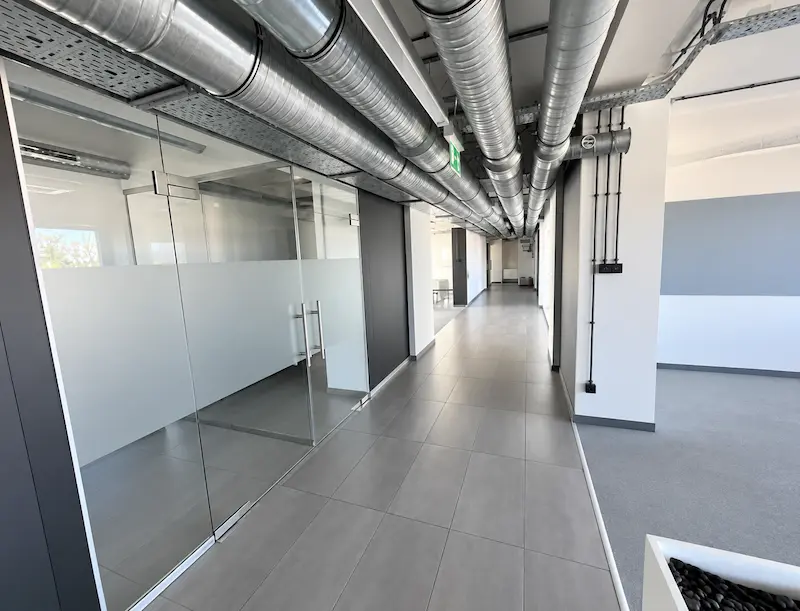
A Class A building is usually expected to combine a strong location, modern individually controllable MEP systems, sufficient clear height for a comfortable fit-out, backup power, security and access control, environmental certification and effective management. During office selection, however, two questions matter particularly: when the building was completed and when its systems were last modernised.
Building age
When it was built
Influences clear height, column grid and technical-system solutions.
Modernisations
What was replaced and when
A properly modernised older building can be better than a newer one that has seen little investment.
Landlord plan
What is planned for replacement
No investment plan in a fifteen-year-old building may signal rising operating costs.
Phase 3Offers and commercial terms
Starting condition
Empty, fitted or previously occupied office space
This is a decision about when costs are incurred and how much freedom the tenant has to shape the office.
| Option | Advantage | Cost of that advantage |
|---|---|---|
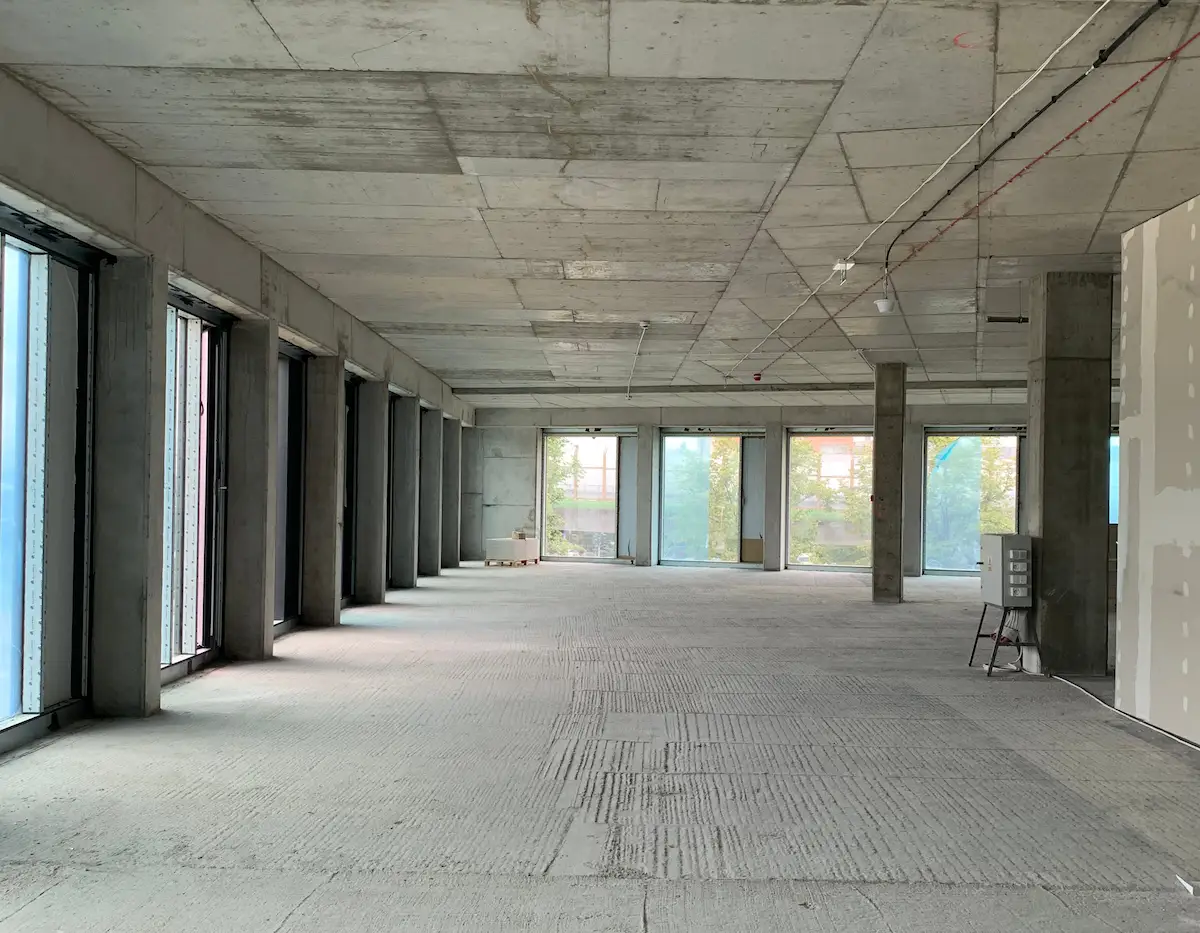
| Shell and core | full freedom over layout and standard | highest entry cost and longest programme |
| Cat A, open standard | floor, ceiling, lighting and air conditioning already installed | internal divisions and MEP adaptation remain with the tenant |
| Landlord-fitted office | fast occupation and low one-off entry cost | layout and standard are imposed and rent is often higher |
| Space after a previous tenant | opportunity to reuse existing elements | value depends on how well the existing fit-out matches the new programme |
With space left by a previous tenant, it is easy to overvalue the existing fit-out. The fact that partitions, glazing or a kitchen already exist is not what matters. What matters is how much of it fits the new programme and remains suitable for further use. If half of the usable scope can be retained, the saving for a space of around 723 m² can reach approximately PLN 330,000. If the fit is poor, demolition creates additional cost instead of savings.
Common basis
Compare office offers on a common basis
The same headline rent can produce a very different total cost once incentives, charges, parking, common-area factors and scope of works are taken into account.
For each offer, add all costs over the full lease term, deduct the value of incentives, add one-off costs on the tenant side and divide the result by the number of months. Only then can you see which office is genuinely cheaper.
| Element | How to include it in the comparison |
|---|---|
| Rent over the full lease term | including indexation and the assumed exchange-rate scenario |
| Service charge | with a growth assumption based on the previous two years |
| Utilities and parking | shown separately because they can vary between buildings more than headline rent |
| Rent-free period | as an amount deducted from the total, not merely a number of months |
| Landlord fit-out contribution | as an amount reducing the tenant’s fit-out budget |
| Cost of preparing the space | the complete fit-out budget for that specific unit |
| Relocation and IT | often similar between offers, but not always |
| Reinstatement of the old office | independent of the new choice, but still part of the project budget |
| Charged lease area | the add-on factor should be checked separately for every offer |
Typical mistake: two offers with the same headline rent but different add-on factors and different landlord scope can differ by more than ten per cent in effective cost. The difference is invisible in a rate table and becomes clear only after all offers are normalised to a single number.
Rate and change over time
Rent and indexation over the full lease term
In a five-year lease, the indexation mechanism can change the cost more than the discount negotiated at the start.
What to establish
The rent currency and exchange-rate fixing date, the index used for annual adjustment, the date of the first indexation and whether the service charge is indexed as well.
What to watch
Euro-denominated rent transfers currency risk to the tenant. It is worth modelling several exchange-rate scenarios and checking whether the lease permits settlement in PLN.
Warning sign
Indexation with no upper limit, indexation applied twice during the first year or an index selected by the landlord from several alternatives.
The lease should clearly define the index, the date of the first adjustment and any annual cap. For a longer lease, the method of setting rent after exercising a renewal option also matters.
Negotiable terms
Landlord incentives as part of lease economics
A rent-free period, fit-out contribution or works carried out by the landlord can be worth more than a small reduction in the headline rent.
A landlord may be more willing to offer one-off incentives than to permanently reduce the base rent. That is why negotiations should cover the complete package rather than one number on the first page of the offer.
| Incentive | What it gives the tenant | What to ask |
|---|---|---|
| Rent-free period | usually covers fit-out time and the first months of occupancy | whether service charge and parking are also waived |
| Landlord fit-out contribution | reduces the tenant’s fit-out budget | amount per square metre, payment mechanism and eligible costs |
| Works carried out by the landlord | removes scope and delivery risk from the tenant | precise scope, deadline and acceptance conditions |
| Reduced rent for an initial period | improves cash flow at the beginning | what the rent becomes after the reduced period ends |
| Parking spaces included | real saving where many spaces are required | for how long and whether it applies to additional spaces |
| Area flexibility | ability to expand or reduce the premises | dates, conditions and the cost of exercising the option |
In practice: negotiate the package — rent, rent-free period, fit-out contribution, parking and landlord works. Only the combined value of these items shows what the negotiation has actually achieved.
Operating costs
Service charge and its variability
The service-charge rate quoted in an offer is a forecast for the next year, not a fixed commitment. Actual costs are reconciled later.
The service charge covers common-area operation, building utilities, security, cleaning, MEP maintenance, insurance, management and taxes. It is normally paid on account and reconciled annually against actual expenditure. That is why it should be assessed using historical costs, not only the next-year forecast.
Cost history for the last two years
Budgets and reconciliations from previous periods show the pace of increases and one-off items much better than the forecast rate alone.
Which costs are passed through to tenants
Check the scope of repair and replacement costs transferred to tenants and the way they are allocated.
Cap on service-charge growth
An annual cap can improve cost predictability across the lease term.
Separate utility settlement
Clarify metering, allocation and how operation of systems outside standard hours is charged.
Point to investigate: a rapidly rising service charge in an older building may indicate increasing maintenance and repair expenditure. Compare it with the age of the MEP systems and the landlord’s modernisation plan.
Commitment horizon
Lease length, financial terms and flexibility
The lease term should reflect how confidently the company can predict headcount, work model and floor-area requirements several years ahead.
Shorter lease
Three years
More freedomfewer incentives
Lower landlord contribution, higher rate and less time over which to amortise fit-out cost.
Consider
a longer lease with clearly defined break and area-change optionsGoal
better commercial terms without losing all flexibilityLonger lease
Five to seven years
Better termsgreater commitment
Higher incentives, lower rate and fit-out cost spread over a longer period.
| Mechanism | What it provides | What the clause should cover |
|---|---|---|
| Renewal option | a right, not an obligation, to continue | notice deadline and how the future rent is determined |
| Break option | ability to terminate part-way through the term | break fee and notice period |
| Right of first refusal on adjacent space | ability to grow without relocating | how long it applies and whether the landlord must notify the tenant |
| Area-reduction option | ability to respond to lower headcount | how much area, on what date and under what conditions |
| Sublease and assignment | ability to give up part of the space | whether consent is required and whether it can be unreasonably withheld |
Conclusion: the less predictable headcount and work model are, the more valuable break, sublease and area-change options become. With a stable team, the stronger commercial terms available under a longer commitment may be more valuable.
Impact on liquidity
Lease security can tie up hundreds of thousands of PLN
It is often omitted from offer comparisons, even though the difference between security forms has a real effect on company cash flow.
| Form | How it works | Impact on the company |
|---|---|---|
| Cash deposit | payment usually equal to several months of rent and charges | directly ties up cash for the full lease term |
| Bank guarantee | the bank guarantees payment to the landlord on demand | bank fee and usually use of part of the company’s credit limit |
| Parent-company guarantee | an undertaking by another group company | does not tie up cash but requires landlord acceptance |
| Submission to enforcement | simplified route for the landlord to pursue claims under Polish law | notarial cost with no direct cash lock-up |
What to ask before signing
- How large is the security and does it increase when rent is indexed?
- In what situations can the landlord use it, and must the tenant first receive a demand to remedy the breach?
- When and under what conditions is the security returned after the lease ends?
- Will the landlord accept a different form from the one proposed in the first draft?
Lease
Lease clauses with the greatest impact on risk
A commercial lease is negotiable to a much greater extent than many first-time tenants assume.
| Clause | Why it creates risk | What to aim for |
|---|---|---|
| Reinstatement at lease expiry | the obligation returns years later as an unplanned cost | a documented target condition, ideally limited to the handover condition |
| Landlord consent for works | no response deadline can block the programme | a response deadline and no unreasonable refusal |
| Mandatory building contractors | monopoly on work affecting building systems | named providers, clear pricing rules and the ability to verify rates |
| Scope of service charge | an open-ended catalogue of costs passed through to tenants | a defined list of costs and an annual growth cap |
| Penalties and interest | can be disproportionate to the breach | balanced obligations for both parties |
| Sale of the building | landlord changes during the lease | continuity of negotiated rights and incentives |
| Force majeure and service interruptions | no relief if the premises cannot be used | a rent-reduction mechanism for longer disruptions |
Important. This guide is not legal advice. A commercial lease, security package and liability provisions should be reviewed by a lawyer experienced in commercial real estate before binding documents are signed.
Phase 4Decision and implementation
When to go technical
Technical due diligence starts with the final two or three units
Earlier it would be too expensive across a long list; later the findings can no longer be used effectively in negotiations.
Location, type of space and commercial terms can initially be assessed from offers and viewings. Before negotiations are closed, however, you need to confirm that the premises can actually support the company. That requires a separate set of questions and technical competence.
Does the programme fit?
Plan-based test
Geometry, column grid, façade module and realistic circulation requirement.
Are the systems sufficient?
Technical parameters
Ventilation for target headcount, electrical power, cooling and data infrastructure.
What does entry cost?
Scope of works
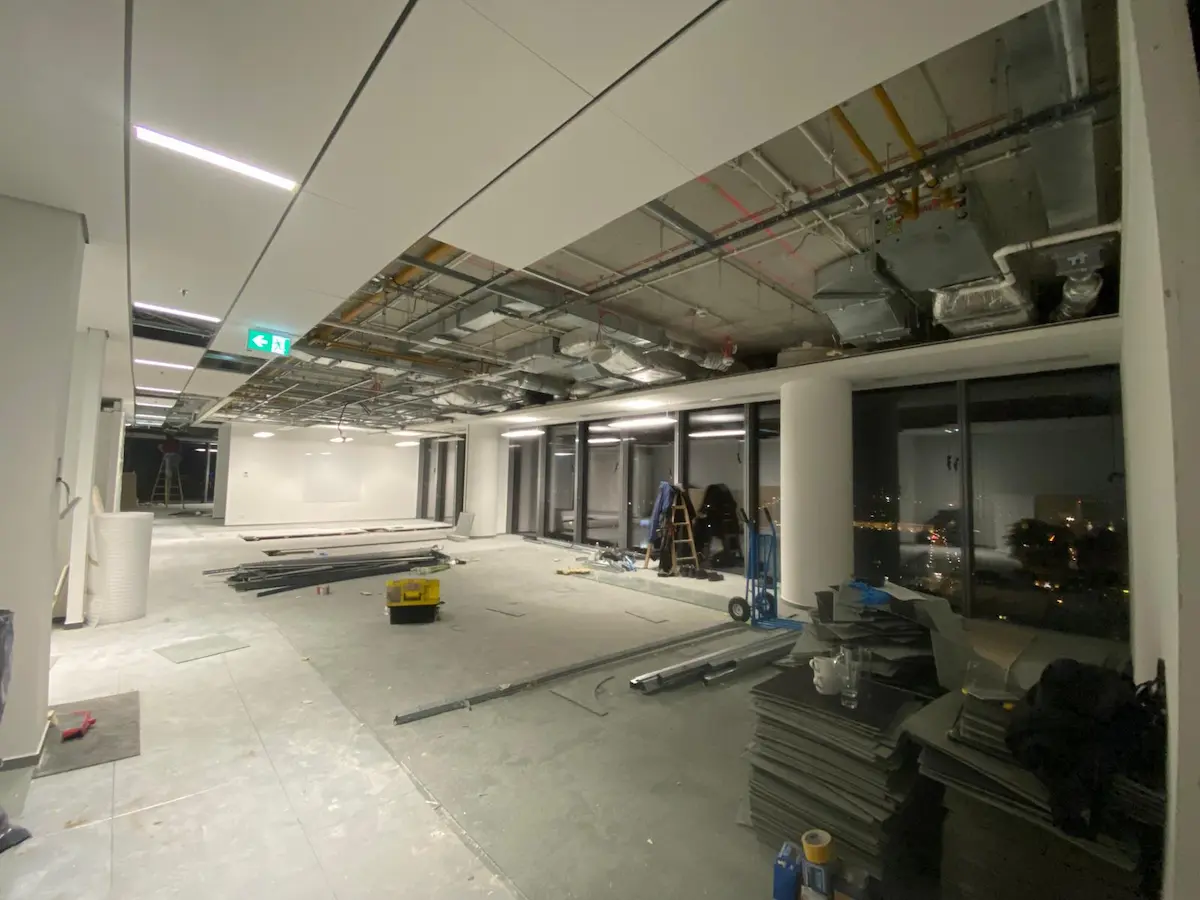
Handover condition, fire-safety requirements and delivery constraints.
The differences can be substantial. For a space of around 723 m², a requirement for fire-rated glazing can add about PLN 494,000 to the preparation budget, an expanded server room about PLN 263,000, and carrying out most works at night about PLN 118,000. Identified before signing, each of these items can support a negotiation. Discovered afterwards, it becomes a cost.
People
An office move is an organisational change, not just a logistics exercise
Even a good location and better working conditions can be received badly if the team only learns about the change after the lease is signed.
The strongest approach is to ask the team about needs and barriers at the beginning, then communicate progress regularly. Consultation does not mean holding a vote on the location. It means collecting useful data and explaining why decisions are being made in a particular way.
Needs assessment
Survey and team discussions before the search begins. Ask about commute, barriers and working patterns.
Communicate the direction
Explain the areas and criteria being considered before the final decision so the change does not arrive as a surprise.
Decision and rationale
Announce the selection together with answers to the most common concerns, especially those related to travel time.
Implementation
Agree rules for the new workplace, booking, quiet zones and hybrid work before the move.
Worth checking: if the new location materially worsens the commute for a large part of the team, include that effect in the decision just as you would rent or building standard. The cost of change does not end with the lease.
Reporting and brand
Building certification and the data required for reporting
Certificates describe aspects of design and management quality. Reporting requires data on actual consumption.
| Element | What it describes | What to ask |
|---|---|---|
| BREEAM, LEED | environmental quality of the building and its management | rating level, year and whether it applies to construction or operation |
| WELL | the building’s impact on user health and comfort | scope of certification and requirements for the tenant fit-out |
| Energy Performance Certificate | calculated energy demand | the indicator value and issue date |
| Consumption data | actual operating efficiency | whether the tenant receives data attributable to its own premises |
| Green-lease provisions | commitments by both parties relating to efficiency | what the landlord specifically undertakes to do |
If the company reports environmental data, access to consumption information stops being an optional extra and becomes a potential exclusion criterion. Some buildings cannot provide this data at tenant level. It is better to establish that during shortlisting than after the lease has been signed.
From decision to first working day
What happens between choosing the office and moving in?
This stage usually takes longer than the first plan assumes because not every task can run in parallel.
| Stage | Indicative duration | What can extend it |
|---|---|---|
| Negotiations and lease | 1–3 months | legal negotiations, changes in decision-makers, landlord scope of works |
| Design and approvals | 1.5–3 months | changes to the programme, building-manager approval, fire-safety coordination |
| Tender and contractor selection | 3–6 weeks | incomplete tender documentation |
| Construction works | 2–4 months | scope, building restrictions, material availability |
| Testing and handover | 2–4 weeks | MEP testing, as-built documentation, building-appointed service providers |
| Move and IT | 1–3 weeks | system migration and weekend working windows |
| Reinstatement of the old office | in parallel | scope agreed under the previous lease |
Time contingency: it is worth keeping at least one month of buffer before the current office must be handed back. A few weeks of overlap between the two leases can be safer than a move under extreme time pressure or a late handback.
What to avoid
Common mistakes when choosing an office
Most of them result not from lack of knowledge, but from doing things in the wrong order or making decisions under time pressure.
| Mistake | Consequence |
|---|---|
| Starting the search too late | negotiating under pressure and choosing from whatever happens to be available |
| Comparing headline rent rates only | selecting the offer that is more expensive in true total cost |
| Using the previous lease area as the new requirement | too much or too little space for the current work model |
| Ignoring the cost of preparing the office | a major unplanned budget requirement in the move year |
| Skipping team-commute analysis | resistance to the move and a real retention risk |
| Technical due diligence after signing | technical problems become tenant costs instead of negotiating points |
| Unclear reinstatement obligations | an unplanned cost at lease expiry |
| Making the decision after one viewing | choosing on impression rather than agreed criteria |
Most important: most of these problems can be avoided if the company defines its needs, required area, budget and move deadline before the first office presentations.
Simple scorecard
Compare the finalists using the same criteria
When offers are similar, it is easy to overvalue the fresh impression from the most recent viewing. A simple scorecard helps structure the decision around priorities agreed in advance.
A scorecard can improve the decision if the weights are defined before the first viewing and each office is rated from 1 to 5 against the same criteria. The proportions below are an example; the weights should reflect the priorities of the organisation and add up to 100 points.
| Criterion | Weight | What is assessed |
|---|---|---|
| Team commute | 20 | distribution of travel-time changes compared with the current office |
| Total cost | 20 | effective monthly cost after all offers are normalised |
| Capacity and geometry | 15 | whether the programme fits without material compromises |
| Condition and scope of works | 10 | what needs to be done and how long it will take |
| Lease flexibility | 10 | break, renewal and area-change options |
| Building quality | 10 | MEP systems, management and predictability of charges |
| Surroundings | 8 | food, services and public realm around the building |
| Image and ESG | 7 | address, certificates and availability of reporting data |
How to interpret the result: the score does not replace management judgement. It does show situations where an intuitive favourite performs poorly against criteria that were previously agreed as important. That gap is a signal to revisit the assumptions or add a missing criterion.
Rules that protect the score
- Weights agreed and recorded before the first viewing.
- Every office rated by the same people against the same criteria.
- Scores entered immediately after each visit, not after all viewings are complete.
- Total cost calculated before the viewing so that visual impression cannot influence the numbers.
Close these points before the decision
Office-selection checklist for a company
Each point should have an answer, an owner or a deadline. Not everything has to be resolved at the same time.
Starting point
- □ move date and notice deadline
- □ attendance data from the current office
- □ work model for the lease term
- □ quantified company programme
- □ required area and growth allowance
- □ three headcount scenarios
Budget
- □ total office occupancy cost
- □ space-preparation budget
- □ move and IT cost
- □ reinstatement cost for the current office
- □ assumed exchange rate and scenarios
- □ management-board approval of the budget
Location
- □ team commute map
- □ peak-hour travel time
- □ public transport and last leg
- □ parking demand
- □ cycle storage and changing rooms
- □ food and services nearby
Offer and terms
- □ add-on factor
- □ rate, currency and indexation
- □ two years of service-charge history
- □ landlord incentives expressed as amounts
- □ scope of landlord works
- □ lease length and options
- □ form of lease security
Lease
- □ reinstatement at lease expiry
- □ rules for approvals of works
- □ mandatory building contractors
- □ scope of service charge
- □ sublease and assignment
- □ legal review of documents
Before the decision
- □ offers normalised to one figure
- □ weighted scoring of shortlisted offices
- □ technical due diligence on two finalists
- □ move-in programme
- □ team communication plan
- □ time and budget contingency
Eight questions you should be able to answer before choosing
1. How many people and what work model does this decision need to support? 2. How much space follows from the programme rather than the previous lease? 3. What is the total cost rather than just the headline rent? 4. How does the team’s commute change? 5. Which offer parameters are still negotiable? 6. How long is the commitment and what flexibility does it contain? 7. What will it cost to bring this specific unit into operational use? 8. Does the programme allow the project to finish before the current lease ends?
Terminology
Glossary of office-offer and lease terms
These terms appear in lease documents and are not always understood in the same way by every party.
- Leasable area
- The area charged under the lease: the area of the premises plus the tenant’s share of the building’s common areas.
- Add-on factor
- A ratio showing how much the charged lease area exceeds the area of the premises itself.
- Workplace capacity
- The number of workstations and rooms that can realistically fit into the space while maintaining the required standards.
- Test fit
- A preliminary functional layout prepared on the floor plan of a specific unit to verify whether the company’s programme fits.
- Base rent
- The rate per square metre of leasable area, usually quoted in euro and paid in PLN after conversion.
- Indexation
- The annual adjustment of the rent according to an agreed index.
- Service charge
- A charge covering the operating costs of the building, normally paid on account and reconciled annually against actual costs.
- Rent-free period
- A period during which base rent is waived, most commonly used while the space is being prepared.
- Landlord fit-out contribution
- An amount provided by the landlord towards preparing the premises for the tenant.
- Fit-out
- The full set of design and construction works required to bring the premises into usable condition.
- Shell and core
- A building with its structure, façade and core complete, with services brought to the boundary of the premises.
- Cat A
- Open-plan finished space with floor, ceiling, lighting, ventilation and air conditioning, but without internal room divisions.
- Cat A+
- A ready-made layout prepared by the landlord, often furnished, available to lease without the tenant carrying out its own fit-out.
- Reinstatement / make good
- The tenant’s obligation to return the premises to an agreed condition at the end of the lease.
- Term sheet / LOI
- A document setting out agreed commercial terms before the full lease is drafted.
- Renewal option
- The tenant’s right to continue the lease on agreed terms after the initial term.
- Right of first refusal
- Priority to lease neighbouring space when it becomes available.
- Sublease
- Letting part or all of the premises to another party, usually subject to the landlord’s consent.
- Bank guarantee
- A form of lease security under which a bank undertakes to pay the landlord a defined amount on demand.
- Handover protocol
- A document confirming the condition of the premises on the handover date and forming the basis for later settlements.
- Tenant representative
- A company representing the tenant in office search and negotiations.
- Serviced office
- Ready-to-use furnished space leased with services, usually for a shorter period and with utilities and support included in the price.
Questions and answers
Frequently asked questions about choosing office space for a company
How do you choose office space for a company step by step?
Start with the company programme and the floor area it requires, then define the full budget, search area and type of space. Only then compare specific offers on a common basis and technically verify the best two or three units. Reversing that order increases the risk of a decision driven mainly by the impression from a viewing.
When should you start looking for a new office?
Count backwards from the move date: 9–12 months for up to 300 m², 12–15 months for 300–1,000 m² and as much as 15–24 months for more than 1,000 m². Allow for negotiations, design, approvals, construction and relocation.
How much office space is needed per person?
A complete office programme usually falls within 8–12 m² per person, including workstations, meeting rooms, offices, kitchen, circulation and support areas. For a 75-person company, the reference programme used here is approximately 723 m², or 9.6 m² per person. Workstation count alone is a poor basis for the calculation.
What makes up the cost of leasing an office apart from rent?
Service charge, tenant utilities, parking, space preparation, furniture and equipment, relocation, IT infrastructure, lease security and reinstatement of the old office to the condition required by the lease. In the 723 m² example, base rent accounts for about 55% of the monthly occupancy cost.
Is it better to negotiate lower rent or larger incentives?
Often, incentives offer more room for negotiation. Headline rent influences building valuation, so a permanent reduction can be more sensitive for a landlord than a one-off rent-free period or fit-out contribution of similar value to the tenant. The important point is to compare the total package.
How long should an office lease be?
A longer lease can support stronger incentives and a lower rate, but it reduces freedom. A shorter lease does the opposite. A good compromise can be a longer term with negotiated options such as a break right, area-change mechanism and right of first refusal on adjacent space.
Is it worth using a tenant representative?
For requirements of several hundred square metres or more, usually yes: an adviser can provide market access and support negotiations. It is still worth asking directly who pays the fee, how the remuneration works and whether the search includes buildings outside the adviser’s own agency portfolio.
Coworking or a dedicated office for a company?
Coworking and serviced offices make sense for smaller teams, high uncertainty around headcount or a shorter time horizon. A dedicated office is stronger for a stable team over several years because cost per person can be lower and the company retains more control over space, confidentiality and infrastructure.
Is fitted office space after a previous tenant cheaper?
Only when the existing partitions, systems, lighting and kitchen match the new tenant’s programme and remain in good condition. Retaining half of the usable existing scope can save around PLN 330,000 on 723 m². If most elements have to be stripped out, a supposedly ‘ready’ office creates additional cost.
How should office lease offers from different buildings be compared?
Normalise each offer to an effective monthly cost: add all costs across the lease term, subtract the value of incentives, add one-off tenant costs and divide the result by the number of months. The add-on factor should be verified separately for each offer.
When should you technically verify an office?
At the stage of the final two or three units, before negotiations are closed. Earlier, detailed technical checks across many options would be unnecessarily expensive; later, the findings cannot be used effectively to renegotiate scope or commercial terms.
What if the new office will not be ready before the current lease ends?
There are usually three options: a short extension of the current lease, temporary serviced office space or a phased move. All have a cost, which is why search timing should be calculated backwards from the move date rather than from the formal lease-expiry date.
Summary
A good office decision is an informed decision, not a search for a perfect office
The goal is not to find a space with no disadvantages. It is to choose a space whose costs, limitations and compromises are understood before the lease is signed.
The greatest value comes from preparation before the search starts: realistically calculated company needs, a full budget rather than the headline rent alone and clear selection criteria. This allows each offer to be assessed against the needs of the business rather than allowing the business to adapt itself to the offer.
Keep the scale of different decisions in perspective. Over a five-year lease for 723 m², a €1 difference in headline rent is worth about PLN 187,000, while a fire-resistance requirement for part of the glazing can add close to PLN 500,000 to the preparation budget. These numbers arise at different stages of the process and require different expertise, but they ultimately land in the same project budget.
needsareatotal budgetlocationtype of spaceofferstermstechnical due diligencedecision
Tools
Define the floor area and budget before office viewings begin
A well-calculated space requirement and budget make it easier to reject offices that do not fit the company from the outset.
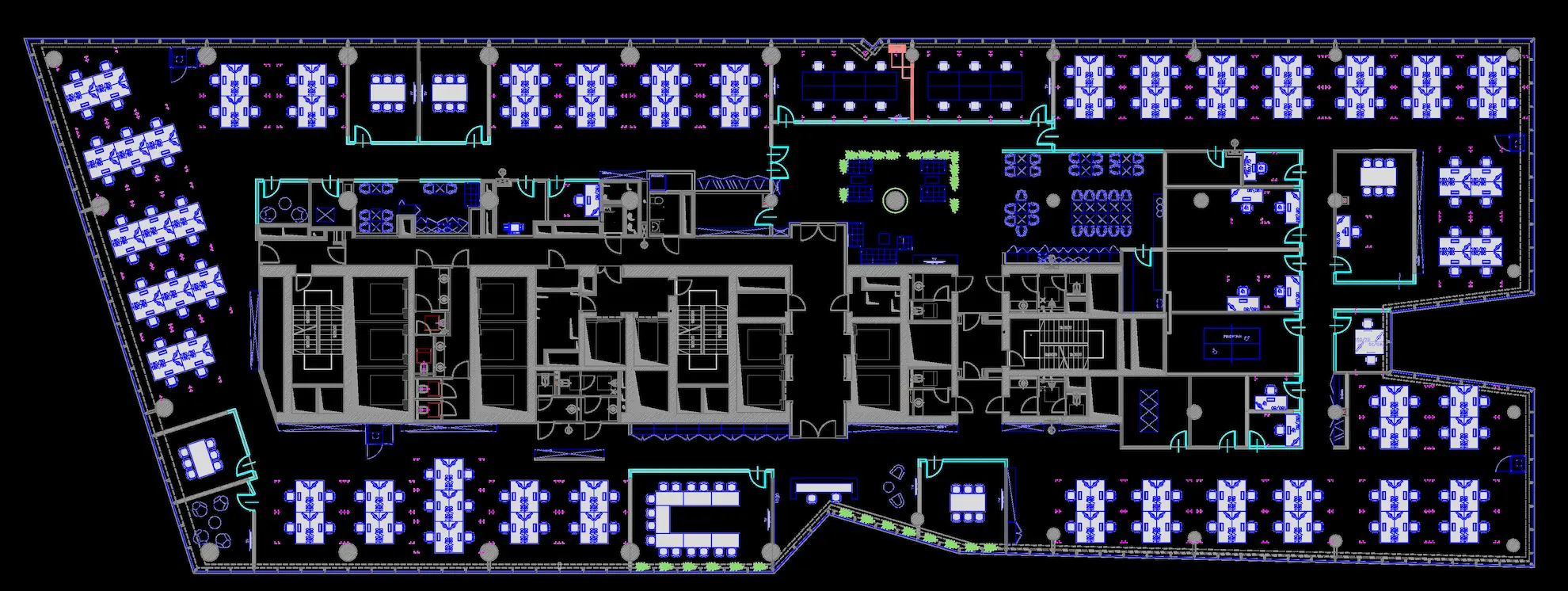
Floor area
Office-space requirement calculator
The calculator combines headcount, workstations, meeting rooms, offices, quiet-work seats and support areas to estimate the required floor area.
Check workplace capacity
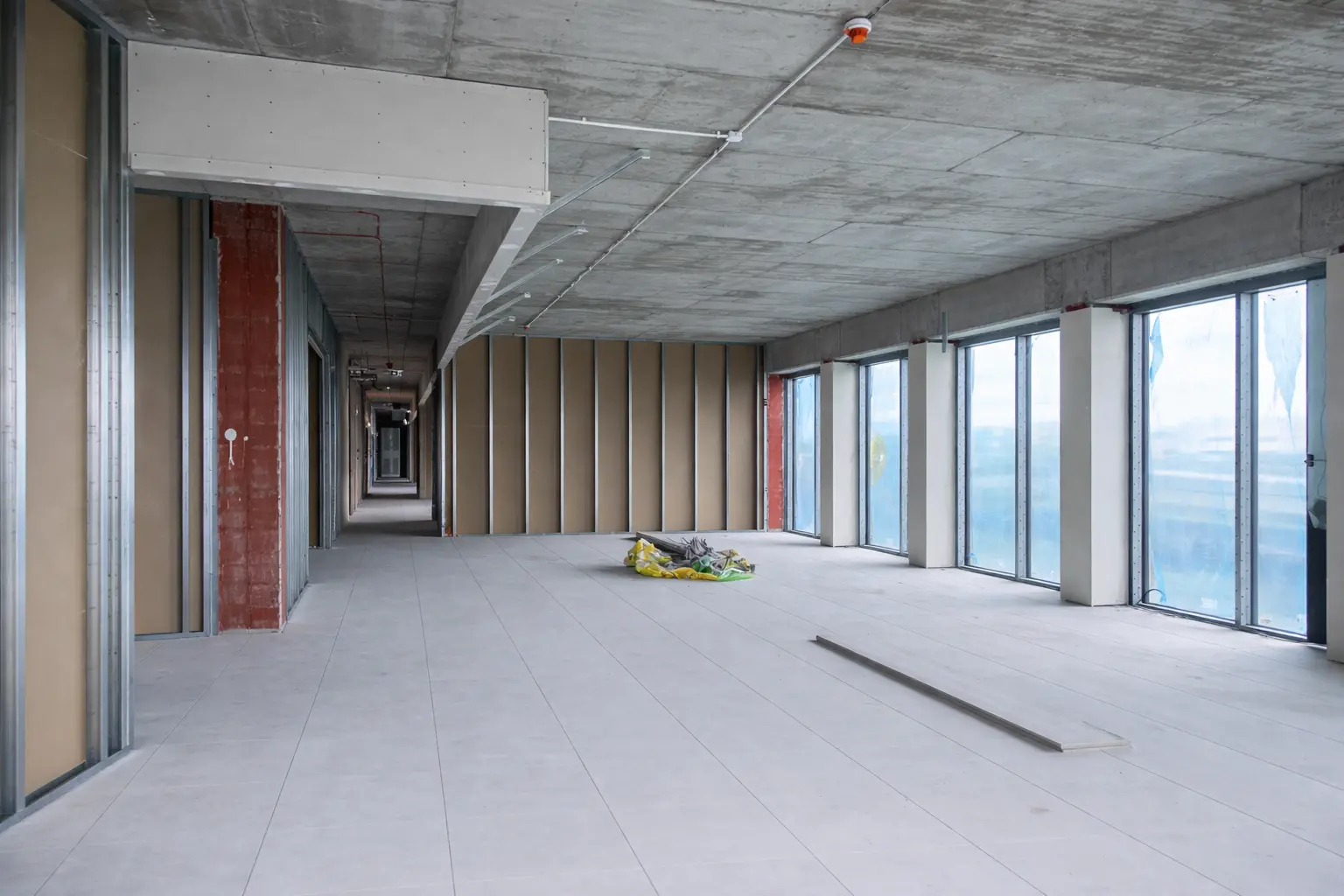
Entry budget
Office fit-out cost calculator
The calculator shows how standard, MEP systems, server-room requirements and reuse of existing elements affect the preparation budget.
Calculate fit-out cost

Specific offers
Compare shortlisted office offers
With several units on a shortlist, the offers can be normalised to a common cost basis and the scope of works can be defined for each space.
Contact Ecoffices
ReadingWhere to start when choosing an office