
What is worth keeping, and what needs to be rebuilt?
An office space left by a previous tenant can be a very good starting point, but only if the decision to keep existing elements is based on an analysis of the layout, installations, finish standard and the real needs of the organisation. The biggest saving does not come from leaving everything as it is, but from clearly distinguishing what supports the new office from what will limit it.
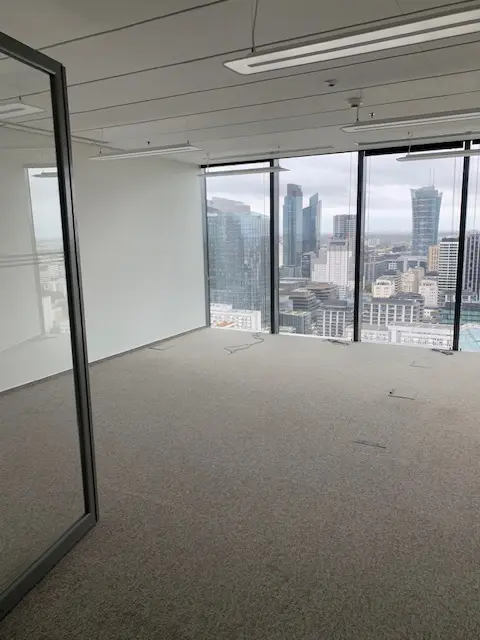
Office fit-out after the previous tenant does not start with demolition
The most important stage is smart office planning. Before we assess wall colours, decorative elements or the appearance of the carpet, we need to define what functions and rooms the organisation really needs.
The first decision concerns the programme: how many workstations, meeting rooms, private offices, focus rooms, quiet work areas, kitchens, video call booths, back-of-house rooms, reception areas or shared spaces are needed. Only then should these needs be compared with the existing layout of the space.
A space left by a previous tenant can help reduce the fit-out budget, but it can also become a source of compromises. That is why it is not worth starting with the question: what can be left as it is? A better question is: what is worth keeping so that the new office is functional, safe and visually coherent?
- elements that fit the new layout,
- higher-cost systems in good condition,
- installations that do not need to be changed.
- glass partitions, doors and built-ins,
- selected areas of carpet flooring,
- decorative elements, if they fit the brand.
- worn or outdated elements,
- solutions that do not fit the concept,
- details that weaken the quality of the new fit-out.
Functional layout first, colours and interior character later
In a fit-out based on a space left by a previous tenant, the key task is to align the organisation’s needs with the existing layout. If part of the walls, rooms and partitions can be reused without losing functionality, the investment budget can be reduced in a real and measurable way.
Changing the layout of rooms is one of the biggest cost drivers. Demolition, relocation or construction of new partitions rarely ends with the wall itself. It usually triggers changes in installations, ceilings, lighting, ventilation, air conditioning, electrical systems, fire alarm systems, voice alarm systems, building management systems, sprinklers, carpet flooring and finishes.
That is why this part of the work is best done on technical diagrams. At this stage, it is worth consciously ignoring the existing colours, decorations and mood of the previous office. First, we check whether the layout works. Only later do we assess how to dress it visually.
A good fit-out is not about keeping as many elements as possible. It is about using the existing space in such a way that every remaining wall, room and installation supports the new way of working.
The most valuable elements may be visible or completely hidden
The next step is to consider keeping elements whose replacement is expensive or technically complex. Some of them are visible immediately: glass partitions, ceilings, doors, built-in furniture, carpet flooring or decorative elements. Others remain hidden, but have a major impact on the budget: ventilation, air conditioning, heat pumps, water mist systems, voice alarm systems, fire alarm systems, building management systems, sprinklers, electrical systems and low-voltage installations.
Changes should lead to a real improvement in functionality, work comfort and safety of use. If something stays only because “it is already there”, but worsens comfort, acoustics, ergonomics or compliance, that saving is only apparent.
- glass partitions and doors,
- suspended ceilings,
- carpets and floors,
- built-in furniture,
- decorative finishes, veneers, slats, wallpapers and stone.
- ventilation and air conditioning,
- fire alarm and voice alarm systems,
- building management systems,
- water mist systems and sprinklers,
- electrical systems, IT network and cable routes.
If the system is still in production, it is often better to modify it than replace it
Glass partitions are one of the first layers worth checking. If the system found in the space is still being produced and its technical condition is good, it is often worth modifying it instead of replacing the whole system.
In that case, some modules can be relocated, missing elements can be added, markings, films or graphics can be changed, and doors can be adapted to the new layout. This often produces real savings without weakening the visual effect.
However, caution is needed when existing glazing forces a poor functional layout. If glass partitions block the proper arrangement of meeting rooms, focus rooms or circulation routes, keeping them may be more expensive than a well-planned rebuild.
A suspended ceiling is not only ceiling tiles — it is also the entire technical layer above your head
A suspended ceiling requires particular caution. The grid and infill panels are available in many designs and budget levels, but ceiling replacement rarely concerns aesthetics only.
The ceiling contains light fittings, ventilation supply and exhaust points, fire alarm detectors, voice alarm system elements, sprinklers, electrical systems, low-voltage installations and often building automation. Replacing or significantly modifying the ceiling therefore means relocating many systems, which can generate a very high cost.
Before deciding to replace the ceiling, it is worth checking whether the existing system can be refreshed, supplemented or used in the new concept. Sometimes replacing selected tiles, cleaning, local repairs and tidying up installations is enough. Sometimes, however, the ceiling has to be rebuilt because it does not match the new room layout or technical requirements.
The most expensive part of a ceiling is not always what you can see. The biggest cost often appears when installations have to be relocated together with the ceiling.
Doors are worth repairing only when they fit the new fit-out concept
Office doors can be an important position in the investment budget, so it is not worth automatically assuming that they must be replaced. If only a few out of many doors have minor surface damage, repairs, adjustments, new fittings or local refreshing can be considered.
The condition is simple: the doors must fit the new fit-out concept. If their colour, veneer, form or visual standard conflicts with the new design, repair may not make sense. In that case, it is better to replace them consciously rather than keep an element that will constantly lower the perceived quality of the office.
It is worth remembering that office doors often do not have standard residential dimensions. Door leaves can be 240–245 cm high, and in more representative spaces even 270–300 cm high. Buying new doors in such dimensions can be a significant cost, especially when there are many rooms.
- when the colour and form fit the design,
- when damage is superficial,
- when fittings and adjustment work correctly.
- when the doors do not fit the new concept,
- when they are heavily worn or deformed,
- when their standard weakens the effect of the whole office.
Carpet flooring wears unevenly, so the entire floor does not always need to be replaced
Carpet flooring is a very visible element of an office, but its wear is rarely uniform across the entire space. It looks different in circulation routes, meeting rooms, under desks and in less frequently used areas.
With carpet tiles, part of the material can often be recovered even if it is 5–7 years old. However, the condition, dirt, discolouration, deformation, smell, furniture marks and availability of the same or compatible product should be checked carefully.
Before replacing everything, it is worth asking two questions: whether full carpet replacement is truly necessary and whether professional cleaning combined with selective tile replacement can deliver an acceptable effect for the new office standard.
Replacing fronts is not always cheaper than making the built-in furniture from scratch
Cabinets, seating, fixed acoustic dividers, kitchenettes and other built-in furniture often look like natural candidates for reuse. They can indeed help reduce the budget, but only when they are functional, well made and suitable for the new layout.
A common mistake is focusing only on replacing fronts. In practice, the cost of making new fronts, keeping or replacing hinges, adjustments, repairs, colour matching and the risk of no guarantee for the proper operation of the whole piece must be compared.
The key question is not only whether we like the built-in furniture. It is equally important to ask: is it useful for us? If the layout of cabinets, kitchenettes or seating does not support the new way of working, keeping them may limit the office more than it helps.
- function and capacity,
- condition of carcasses and fronts,
- hinges, runners and fittings.
- cost of new fronts,
- cost of repairs and adjustments,
- cost of making everything from scratch.
- no guarantee for modifications,
- mismatch with the new function,
- apparently cheap modernisation.
There are no ugly things — only things that do not fit the rest
Stone, veneer, wallpapers, moss, slats, mouldings and other decorative elements can have significant value. The problem is that they do not always fit the new organisation, its brand identity and its way of working.
Office colours are part of organisational identity. Decorative elements build atmosphere, reflect the way people work and reveal the company culture. Sometimes keeping expensive elements makes sense because they are neutral, elegant and easy to include in the new concept. Sometimes, however, they are a symbol of a specific design era or of the previous tenant.
Then the question is not: was this element expensive? The real question is: do we want the new space to be perceived in this way because of it?
The budget has to be treated as a whole. Installations cannot be ignored, but small details should not be overlooked either: light switches, sockets, trims, handles or grilles. On a refreshed wall, a worn-out detail can stand out immediately and spoil the effect of the entire fit-out.
12 questions before fitting out an office after the previous tenant
Do we know what functions and rooms our organisation really needs?
Does the existing wall layout support the new work model, or does it only seem to fit?
How many partitions need to be built, moved, removed or kept unchanged to achieve a good layout?
Do layout changes require moving ventilation, air conditioning, fire alarm systems, voice alarm systems, building management systems, sprinklers, electrical installations or IT networks?
Are the existing glass partitions still in production and can they be modified?
Can the suspended ceiling be refreshed, or does changing it require costly installation works?
Do the office doors match the new fit-out in colour and quality?
Does repairing the doors make sense, considering their height, standard and replacement cost?
Does the carpet need to be replaced entirely, or is cleaning and selective tile replacement enough?
Is the built-in furniture truly functional, or does it only appear to save budget?
Do decorative elements, colours and materials fit the brand identity and culture of our organisation?
Does the budget also include small details: switches, sockets, handles, trims, grilles and finishing elements?
The best reuse is the one that does not look like a compromise
Office fit-out after the previous tenant can be a very sensible way to reduce the investment budget, shorten the schedule and reduce waste. The condition is a smart analysis: first function and layout, then installations, then finishing elements, built-in furniture, decorative elements and details.
Not everything that already exists is worth keeping. Not everything that is worn out has to be replaced automatically. The key is to check whether a given element fits the new office programme, brand standard, employee comfort, technical requirements and the budget of the whole process.
A well-executed fit-out ensures that a space left by a previous tenant does not look like an office “after someone else”. It looks like a consciously designed workplace in which some existing elements were reused because they made sense — functionally, technically and financially.