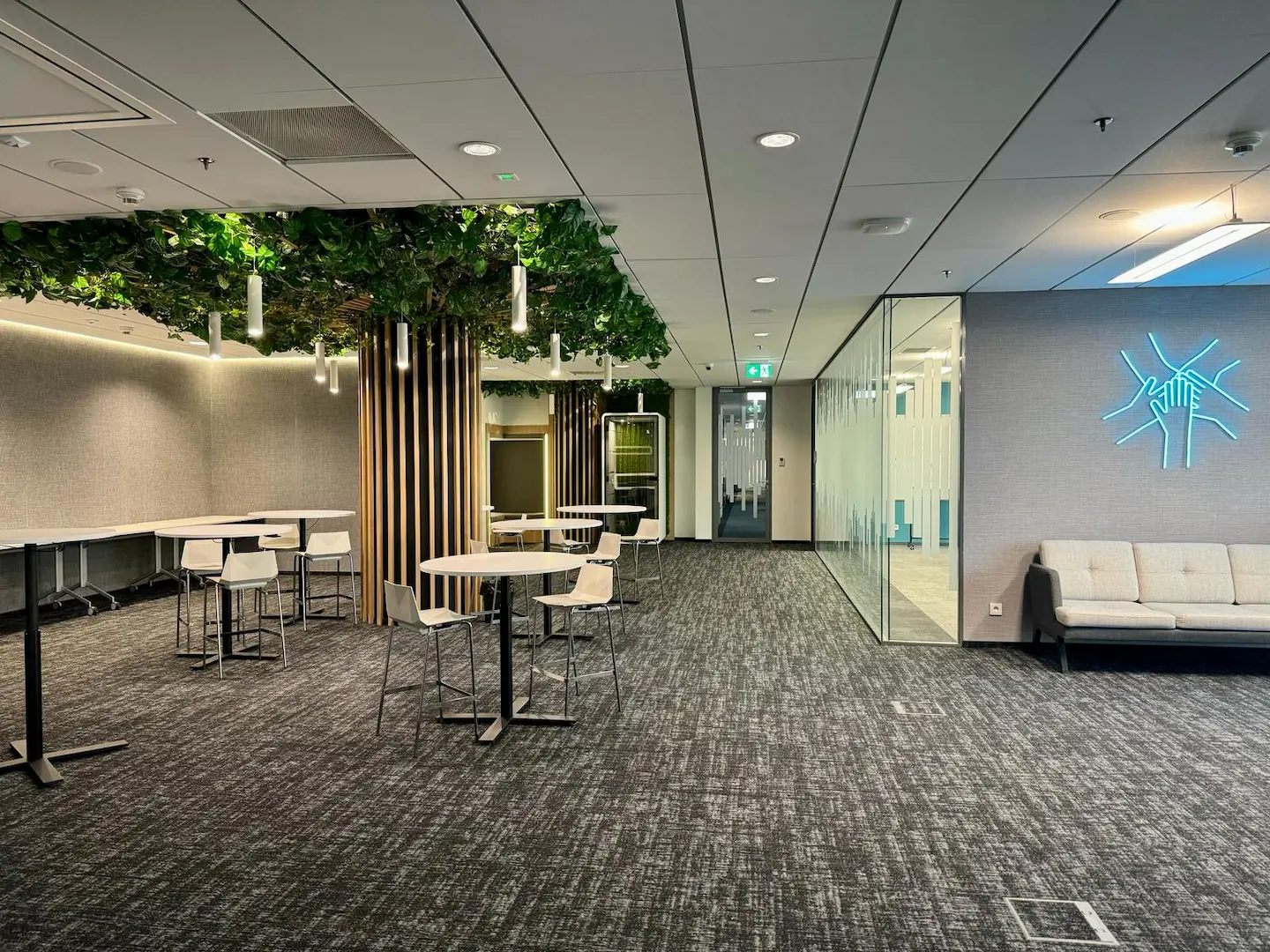
Warsaw remains the largest, most liquid, and most competitive office market in Poland, but in 2025–2026, the logic of office design has clearly changed. A few years ago, you could think about an office mainly through the prism of aesthetics, the prestige of the address, or the rent level. Today, such an approach is too shallow. In practice, it is no longer enough.
The market operates differently. New supply is scarce. According to market reports, relatively little new office space hit Warsaw in 2025, while the city’s total stock decreased because some older buildings were withdrawn from the market, repurposed, or assigned to other functions. Central zones remain the strongest, and the availability of good space there is distinctly more limited than outside the center. This is not just a piece of trivia for real estate advisors. It directly affects how new headquarters are planned and existing offices are modernized.
In such an environment, an office can no longer be just a “pretty interior” that simply looks good in photos. It must perform specific business tasks. It is supposed to support hybrid work, increase team efficiency, build a competitive advantage in recruitment and retention, strengthen organizational culture, respond to ESG requirements, and simultaneously remain feasible within a realistic budget and schedule. With rising fit-out costs and pressure on deadlines, every design error costs more today than it used to: financially, operationally, and in terms of image.
Therefore, in 2026, designing office interiors in Warsaw is no longer about picking colors, furniture, and a striking reception desk. It is about building a work environment that works. This distinction is crucial. The best offices today are not the most decorative ones, but those best tailored to the company’s work model, the building’s requirements, the logic of use, team processes, and the organization’s long-term goals.
Below are the key trends that genuinely dominate office design in Warsaw today. Not as a collection of Pinterest inspirations, but as concrete design, technical, and functional decisions.
1. The office as a business tool, not a “pretty interior”: Workplace Strategy before the concept The biggest change in recent years is not about how offices look. It is about where the design even starts. In a mature approach, design does not start with a mood board, naming a style, or choosing wall claddings. It starts with Workplace Strategy. This is exactly where the most important decisions are made, which later translate into both the quality of the office’s operation and the budget, acoustics, technology, the number of meeting rooms, desk density, or the level of user frustration. In practice, this means that before the concept, you have to answer much more fundamental and demanding questions. What roles work in the organization? How often does the team meet formally, and how often do they collaborate spontaneously? How much time do people spend on tasks requiring focus? How many conversations take place online, and how many in person? What are the peak attendance days? Which departments must sit close to each other, and which need a more separated environment? How important is conversation confidentiality? How often do guests, candidates, or business partners visit? Only from such a diagnosis should the space plan emerge, and only later the finishing standard and aesthetic language. Otherwise, the design is inverted: first, the packaging is created, and only then do you try to fit the real functions of the company into it. This is exactly why pre-design workshops, office utilization analysis, mapping activity types, and modeling attendance scenarios are playing an increasingly important role. It is not about a formality or a trendy consulting stage. It is about mitigating the most expensive type of mistake: designing a beautiful office that turns out to be dysfunctional after six months. In Warsaw, this trend is especially important because market pressure is high. Good space in central locations is not a resource that can be wasted today. Since the vacancy rate in the center remains distinctly lower than outside the center, every square meter in a well-located building has greater operational and financial value. Even more so, the office must be designed as a precise work tool, rather than a generic “office arrangement.”
2. Hybridity 2.0: Activity-Based Working instead of hot-desks “on principle” One of the biggest misunderstandings of recent years was reducing hybrid work to a simple slogan: “we are eliminating assigned desks.” This was too shallow. In mature Warsaw projects of 2026, it is no longer just about hot-desking. It is about Activity-Based Working, meaning an office built around real activities, not around a duplicated layout of rows of desks. This is a very important difference. In a poorly understood hybrid model, companies simply reduced the number of desks but did not increase the number of small meeting rooms, focus zones, places for brief online calls, or project spaces. The result was predictable: more chaos, more conversations in the open space, greater tension between teams, and a feeling that the office “doesn’t work.” Mature ABW looks different. It assumes that different work environments must exist in the office to correspond to different tasks. You need places for deep concentration, places for teamwork, spaces for quick 2-4 person meetings, project rooms, booths for online calls, micro-VC rooms, touchdown areas for people dropping in for a moment, and social zones that act as the soft heart of the organization. In this model, the standard desk ceases to be the only planning unit. The unit becomes the activity: focus, conversation, workshop, presentation, mentoring, onboarding, project work, quick sync, video conference, rest, interaction with a guest. This changes everything: program proportions, acoustics, technology, lighting, and occupancy management. A good hybrid office in Warsaw in 2026 is therefore less “homogeneous” and more layered. And that is exactly why its design cannot be created without prior analysis of the company’s work. The layout of the space alone does not solve the issue. ABW works only when it is aligned with the organizational culture, the rules of using the office, the booking system, and the actual number of available resources. This is important from an efficiency perspective. A poorly designed hybrid lowers productivity because it transfers organizational friction into the daily user experience. A well-designed hybrid does the opposite: it reduces the number of micro-problems, accelerates collaboration, and lowers the cost of chaos.
3. “Earning the commute”: the office must justify the trip with experience and quality The most important psychological change following the period of mass remote work is simple: today, an employee does not come to the office “because they have to,” but increasingly because they see the point of coming. This phenomenon is often referred to as earning the commute. In practice, this means companies can no longer base workplace attractiveness solely on the address or finishing standard. The office must offer value that home does not: quality of collaboration, mentoring, organizational culture, faster knowledge flow, easier decision-making, team integration, contact with leaders, events, and a sense of belonging. This is exactly why the destination office model is growing in importance in Warsaw. The office becomes a destination worth visiting because it offers a specific experience and concrete benefits. From a design standpoint, this translates into a clear increase in the role of common, representative, and social spaces. In practice, this is visible in the hospitality office trend. Kitchens cease to be just back-office facilities and become one of the office’s key focal points. Receptions are designed more like lounges than traditional service desks. Meeting rooms are more refined visually and technologically. Town hall spaces emerge—places for presentations, all-hands meetings, workshops, and internal events. This is not a “soft” decorative trend. It is a real answer to the war for talent. In a labor market where companies compete not only with salary but also with the employee experience and the quality of the daily work environment, the office becomes an element of employer branding. Not in the sense of a poster on a wall, but in the sense of a real experience: do I want to come back here? Does this place support my work? Do I have somewhere to talk in peace? Can I meet the team in conditions conducive to collaboration? In this sense, the best offices in Warsaw today are neither the most minimalist nor the most luxurious. They are the most useful, the most refined in terms of experience, and the most consistent with the reasons why people should come to them in the first place.
4. Acoustics as a hard standard, not an add-on: ISO 22955 and open space best practices One of the most underestimated topics in office design is acoustics. And yet, it is precisely what most often determines whether users find the office comfortable or exhausting. In an open space, the square footage itself is rarely the problem. The problem is noise, lack of privacy, and lack of control over stimuli. That is why acoustics has ceased to be a “nice to have” and has become a hard element of design. ISO 22955 provides technical guidelines regarding the acoustic quality of an open office and clearly shows that the subject should be treated systemically—from the planning stage and functional layout, through materials and construction solutions, all the way to how the space is used. What does this mean in design practice? First, acoustic zoning. Noisy functions cannot be in direct contact with quiet work zones. The kitchen, hub, printers, traffic routes, and places for spontaneous meetings should not be located in a way that “spills” noise toward workstations requiring focus. This sounds trivial in theory but is often poorly executed in practice. Second, conversation infrastructure. Phone booths, micro-rooms, and small rooms for brief online calls are not a premium add-on. In a hybrid office, they are a core infrastructure element. If they are missing, people take their calls to the open space and destroy the comfort of everyone else. Third, materials and geometry. A carpeted floor and a suspended ceiling or a few wall panels alone do not solve the problem. Effective acoustics is a combination of absorptive surfaces, controlled space geometry, appropriate partitions, ceilings, furniture, and visual-acoustic barriers. Fourth, the logic of circulation. If the main traffic route cuts through focus zones, even the best materials won’t help much. The design must anticipate how people move around the office. Fifth, rules of use. The best acoustics will not work without office etiquette. An office is not just architecture. It is also rules: where we talk, where we work in silence, where we conduct online calls, how we use common zones. A good Warsaw office in 2026 doesn’t “have acoustics.” It has an engineered acoustic system.
5. Wellbeing in parameters: air quality, lighting, and thermal comfort The word wellbeing is sometimes overused, but in mature office design, it no longer means “nice perks.” It means measurable parameters of the internal environment that affect the health, focus, mood, and performance of users. The WELL Building Standard treats comfort, light, air, and other elements of the work environment as areas subject to design, measurement, and management.
Lighting: not “just to make it bright,” but to make it good for working In office projects, lighting is one of the most underappreciated carriers of quality. Too weak, poorly placed, or glaring light can destroy even a well-planned space. For office workstations, PN-EN 12464-1 remains an important reference point, and in practice, one of the typical requirements for computer work is around 500 lx and appropriate color rendering quality. This is the technical minimum, but in the offices of 2026, something more is growing in importance: lighting scenes, glare reduction, the conscious use of daylight, and tailoring lighting to specific activities. In design practice, this means several things. Workstations cannot be placed mindlessly relative to glazing. Meeting rooms should have different lighting scenes for presentations, workshops, and online meetings. Focus zones can be neither overexposed nor too high in contrast. Booths and small VC rooms must also be designed with the face in the frame and shadow reduction in mind.
Air and microclimate: sensors and real-time control More and more modern offices use CO₂ sensors and other air quality sensors, as well as occupancy-based ventilation control strategies. Demand-controlled ventilation based on CO₂ sensor readings is a known method of adjusting the ventilation system’s operation to the actual conditions in the space. In an office, this means not only potentially better energy efficiency but also more predictable user comfort. In practice, this means moving from static assumptions to live environment management. If a zone is temporarily more heavily occupied, the system should be able to read this and react. This is especially important in the hybrid model, where attendance is uneven: Tuesday and Wednesday might look completely different than Friday. Added to this is thermal comfort. An office that is too warm or too cold immediately lowers the subjective rating of workplace quality. And again: it is not solely about HVAC parameters, but their combination with the spatial layout, sun exposure, shading, and controls. In a modern Warsaw office, wellbeing should not be a marketing message. It should be embedded in the documentation, the design, and the subsequent building management.
6. ESG and sustainable fit-out: the circular economy in practice Not long ago, the topic of ESG in offices was seen mainly as a corporate requirement or a reporting element. In 2026, that is no longer enough. ESG is becoming a real design, technical, and cost criterion. In fit-outs, the circular economy—thinking about the interior in terms of its life cycle, not just at the point of handover—is particularly growing in importance. The World Green Building Council points to fit-outs as an important area for a circular built environment, and market practice increasingly promotes reuse, longer material life cycles, and designing for reconfiguration. JLL also shows that circular solutions in a fit-out can limit embodied carbon and waste volumes. In the practice of Warsaw projects, this translates to several concrete decisions. First, reuse where it makes technical and aesthetic sense. It is not about an ideological “keep everything.” It is about the sensible use of what can be preserved or repurposed: ceiling elements, light fixtures, floor boxes, parts of walls, certain furniture, fragments of installations, or glass. Second, materials with better environmental information. EPDs (Environmental Product Declarations), LCAs, and manufacturer transparency are increasingly important. Investors no longer ask only about color and price. They increasingly ask about the environmental footprint and the possibility of future replacement without generating excessive waste. Third, designing for a longer life cycle. The worst environmental and cost scenario is an office that requires extensive reconstruction after two years because it was designed too rigidly. A well-designed office has a certain capacity for adaptation. Fourth, modularity and standardization. This word might sound technical, but it is of immense importance. The more predictable and repeatable the solutions are, the easier they are to manage, service, and modify at a lower environmental and financial cost. As a result, ESG should not be a separate “chapter” of the project. It should permeate decisions regarding material, layout, technology, modernization logic, and execution method.
7. Smart office without “gadgets”: technology as efficiency infrastructure One of the most mature trends of 2026 is the departure from technology as a spectacle. Today, a smart office does not mean a greater number of screens. It means a better-designed, quiet, and effective infrastructure. The greatest value comes from solutions that the user feels as the fluidity of the office’s operation, rather than as a technological attraction. The first area is booking and resource management. In a hybrid office, booking desks, rooms, project zones, or parking spots is not a luxury. It is an element of organizational order. If the system is well-integrated with the calendar and intuitive for the user, it reduces chaos and improves the predictability of the workday. The second area is occupancy analytics. Occupancy data ceases to serve solely facility management. It becomes the basis for decisions regarding spatial layout, the number of meeting rooms, the ratio of desks to touchdowns, the attendance distribution, and future modernizations. In this sense, technology is not meant to control people, but to optimize square meters. The third area is the videoconferencing standard. This is where you can see just how different the office of 2026 is from the office of a decade ago. Today, a small 2-4 person room with poor acoustics, random lighting, and a weak camera does not meet requirements. Videoconferencing has become one of the fundamental work modes, so audio, camera, screen, background, lighting, and privacy must be designed as a cohesive whole. The fourth area is access control and information security. The more hybrid and multi-layered the office is, the greater the importance of access zoning, privacy in rooms, the appropriate placement of confidential functions, and designing the space with data security in mind. The best office technology today is virtually invisible. It does not distract from work. It simply makes the office run more smoothly.
8. Modernizations and “second best locations”: design as a way to maintain competitiveness The Warsaw office market clearly shows that not every company in 2026 will move to a new, flagship building in a top location. Limited supply, cost pressure, and a shrinking stock of some older assets mean that two scenarios are becoming increasingly important: modernizing an existing office and choosing a well-connected location outside the strict city center. This trend is also visible in the broader context of some older offices being withdrawn from the market and the growing importance of repositioning and value-add. This is a very important point, because for years modernization was treated like a “cheaper version of a new office.” Meanwhile, a well-planned modernization is not about a facelift. It is not about new paint, a few acoustic panels, and a different reception desk. It is about improving function, ergonomics, circulation logic, acoustics, technology, and space utilization efficiency. In practice, some older Warsaw offices still hold great potential if approached correctly. They might have good transport links, a solid structure, and a sensible address, but lose out due to an outdated layout, poor acoustics, an insufficient number of small rooms, a too-rigid open space, or a worn-out aesthetic language. In such cases, design is not an ornament. It is a tool for restoring competitiveness. Modernization in 2026 should therefore start with the same thing a new office starts with: a diagnosis of function, technology, installations, building constraints, and usage scenarios. In an older facility, this is even more critical because the risk of collisions, technical limitations, and unforeseen costs is higher. That is precisely why well-executed modernizations today are often more demanding than a fit-out in a new space. They offer a better chance to optimize CAPEX, but only when they are designed with full awareness of the existing constraints.
9. Local identity within a global standard: “Warsaw DNA” in the details Corporate offices suffered from the same problem for years: they could be located practically anywhere. They were correct, but interchangeable. In 2026, the departure from this anonymity is increasingly evident. In Warsaw, the importance of local narrative is growing, but in a much more mature form than before. It is no longer about literally decorating the office with photos of the Palace of Culture or a city map on the wall. It is about subtly weaving the local context into the space in a manner consistent with the employer brand. This can mean naming rooms inspired by districts, places, or cultural tropes related to Warsaw. It can mean collaborating with local illustrators, using local craftsmanship, material details, typography, colors, or objects rooted in the location. It can also mean more abstract references: the rhythm of the city, the layering of history, the contrast between modernity and pre-war urban fabric, rawness and elegance combined. One thing is paramount: such a motif works only when it is not an accidental decoration. It must stem from the brand, the organizational culture, and the company’s tone. Otherwise, it quickly becomes meaningless scenography. Properly utilized Warsaw DNA strengthens the experience of the place. It ensures the office isn’t just “pretty,” but grounded. For employees and guests, this often makes a bigger difference than the most expensive finishes lacking identity.
10. Costs and budgeting in Warsaw: why “cheaper” often means “more expensive” In 2026, designing an office in Warsaw is clearly shifting away from thinking in terms of “pretty vs. modest.” The division into decisions that are cheaper only on paper versus decisions that are genuinely optimal is becoming far more important. This is a key distinction. The most expensive office does not necessarily result from a high standard. Very often, it stems from decision-making errors:
- too late changes,
- underestimated installations,
- lack of a sufficient number of small rooms,
- lack of element standardization,
- ignoring the building’s logistics,
- wrong assumptions about occupancy,
- mismatching the program to the square footage. In the Warsaw market, where good space in the center is limited and schedules are tight, the cost of a mistake grows. If the design does not take into account the realities of the building, approval procedures, fire safety constraints, BMS systems, delivery logistics, or phasing of works from the very beginning, then apparent savings at the concept stage quickly turn into surcharges during execution. Market data shows that the availability of high-quality space, especially in the center, is decreasing, so designing “without errors” and foreseeing problems before they appear on the construction site are becoming increasingly important. That is exactly why the design for delivery approach is gaining prominence. This is design that does not stop at a drawing of an attractive interior but factors in feasibility. Such a design is synchronized with technical realities, material availability, the number of unique details, the pace of investor decisions, building management requirements, and execution logic. In practice, the most cost-effective office is not always the cheapest one in the initial estimate. It is the office that least frequently requires costly corrections, redesigns, and salvaging the situation during execution.
11. Recruitment and retention: the office as part of the employer’s value proposition A few years ago, the argument “a nice office helps in recruitment” was sometimes overused and oversimplified. In 2026, it is worth approaching this more maturely. An office won’t hire people for the company. But it can tangibly strengthen or weaken the employer’s proposition. This happens because candidates and employees no longer evaluate the office solely through the prism of design. They evaluate it through the prism of daily experience:
- does the commute make sense,
- can you focus,
- are there places for online calls,
- do meetings run smoothly,
- does the space build a sense of quality,
- does the company look well-organized,
- does the office support relationships and team culture. For many organizations, the office is becoming tangible proof of how seriously they treat people’s work. If the space is unrefined, noisy, haphazard, devoid of privacy, and technologically inefficient, the employee reads this more broadly: as a signal about the quality of management. On the other hand, a well-designed office supports onboarding, mentoring, cross-departmental meetings, bond building, and knowledge exchange. This is especially crucial where a company competes for specialists and leaders, and salary alone is no longer the sole area of advantage. In this sense, the office is not an image cost. It is part of the employer’s architecture.
12. Sqm efficiency: every meter must work today In the competitive Warsaw market, an office is too expensive to be planned intuitively. Every meter should be working today. But this does not mean blindly maximizing density. It means maximizing utility value per meter. This is a very important distinction. Misunderstood efficiency is cramming in more workstations. Well-understood efficiency is a layout in which, on a given square footage, the team can operate smoothly, without excessive resource conflicts, without acoustic overload, without queues for meeting rooms, and without a loss of collaboration quality. Therefore, in 2026, occupancy analytics, attendance scenarios, growth forecasting, layout flexibility, and zoning for variable use are gaining ever greater importance. It is not about the office being as “full” as possible. It is about ensuring that it does not become dysfunctional on its peak days, and does not feel empty and haphazard on quieter days. The best Warsaw projects manage to find the balance between sqm efficiency and user experience. It is precisely this balance that dictates quality today.
13. Conscious design of small rooms: conversation, VC, focus One of the strongest practical trends of 2026 is the growing importance of small rooms. It might sound inconspicuous, but it is one of the most critical elements of a modern office. In many organizations, the number and quality of small rooms dictate whether the office is functional. 1:1 conversations, quick calls, managerial meetings, candidate interviews, rapid briefings, confidential consultations, sudden online connections—all of this doesn’t happen in large conference rooms. It happens precisely in small rooms, booths, and micro-meeting rooms. If there are too few of these spaces, the problem spills over the entire office. Conversations spill into the open space. 8-person rooms get blocked by two people. Noise increases. The availability of larger rooms drops. Frustration levels rise. That is why in 2026, designing small rooms cannot be just “supplementing the program.” It is one of its foundations. These rooms must be accurately quantified, appropriately dispersed across the floor plan, acoustically refined, and technologically ready for hybrid mode.
14. Designing for volatility: the office must be reconfigurable One of the most important takeaways from recent years is that organizations are changing faster than they used to. They change the headcount in teams, the attendance model, the departmental structure, the level of centralization, the way meetings are run, and even the very meaning of physical presence in the office. This means that the 2026 office should not be designed as a “forever” layout. It should possess a certain capacity for change. In practice, this means designing with reconfiguration in mind:
- limiting the excess of overly rigid solutions,
- sensible standardization of walls, doors, and details,
- a modular approach to built-ins,
- thoughtful allowances in installations,
- the ability to relatively easily change the function of certain zones. This matters not only operationally but also environmentally. An office that can be adapted without extensive dismantling is simply more economically sensible and aligns better with ESG logic.
15. Error-free design: why revisions are the most expensive today If one had to point out a single sentence summarizing the Warsaw design trend of 2026, it would probably be this: the cheapest decisions are those made at the right time. In a market where the supply of good space is limited and execution/approval timelines remain a significant risk, revisions become extremely expensive. This applies to design changes as well as execution corrections or late user decisions. The most expensive things are usually not premium materials. The most expensive things are:
- poorly thought-out layouts,
- decisions postponed until the execution phase,
- underestimated installations,
- lack of coordination between technology and architecture,
- unforeseen building management requirements,
- “retrofitting” functions after work has commenced. That is exactly why mature companies increasingly invest more attention and work into the pre-execution phase. It doesn’t slow down the project. In the long run, it usually stabilizes it.
Investor checklist: 12 questions worth closing before starting a project Before you start designing an office in Warsaw in 2026, it is worth answering at least the following questions:
- How precisely do we define our work model, and how does team attendance practically distribute across the days of the week?
- Which tasks in our company absolutely require working in full focus, and which rely on loud, dynamic cooperation?
- What are the reliable proportions of our daily meetings—how many are calls, how many are in-person, and how many are mixed (hybrid) connections?
- Have we planned a sufficient number of booths and micro-rooms to prevent mass videoconferencing from taking place in the open space?
- How will we physically and acoustically isolate the bustling social and circulation zones from areas requiring deep concentration?
- Has the lighting system been diversified with the ergonomics of specific tasks in mind (working at a monitor, reading, brainstorming), or merely for a general visual effect?
- What solutions will we implement to continuously monitor and regulate air parameters and temperature depending on the office’s current density?
- How will we put ESG assumptions into practice—what can we rationally reuse, and what circular materials will we reach for?
- Which smart office systems will actually optimize daily work (e.g., booking systems, occupancy analytics), and which are merely expensive gadgets?
- Does our space have the appropriate flexibility to organize training, onboarding, or a town hall meeting for the entire company without logistical chaos?
- In what authentic, unobtrusive way will the office design reflect the culture of our organization and the local Warsaw context?
- What hard technical constraints does the building itself impose (HVAC capacity, fire safety regulations, delivery logistics), and how will they affect our budget and schedule?
If there are no answers to these questions, the project is exposed to errors even before the first visualizations are created.
Summary: what really dominates in Warsaw in 2026? The most important trends in office design in Warsaw in 2026 can be summarized as follows. First, the office is a business tool today, not a decoration. Workplace Strategy, activity analysis, and conscious attendance modeling become the starting point. Second, hybrid work has matured. Activity-Based Working no longer means just reducing the number of desks, but building a full system of work environments: focus, collab, VC, social, touchdown. Third, the office must earn the commute. User experience, the quality of common spaces, hospitality, and workplace culture are becoming a real answer to the war for talent. Fourth, comfort is parametric. Acoustics, light, air, and microclimate are being designed more and more from an engineering standpoint, rather than being treated as an aesthetic background. Fifth, ESG is entering fit-out practice. Circular economy, reuse, lower material footprint, modularity, and designing for a longer life cycle are becoming the market standard, not a niche. Sixth, with low supply and strong demand, especially in the center of Warsaw, designing “without errors” is growing in importance. Good space is too valuable to waste on misguided assumptions, bad functional proportions, or late revisions. In short: in Warsaw 2026, the winning office is not the one that looks most spectacular on a render, but the one that most accurately combines work strategy, engineering, organizational culture, and business efficiency.